Please use this form if you would like to have this math solver on your website, free of charge.
Example 1
Solve: logx 100 = 2.
Rewrite in exponential form.
Take the square root of each side.
Simplify.
x2 =
x =
100
± 10
Since x is the base, it must be positive. Therefore, -10 is not a solution. The solution is x = +10.
So, log10100 = 2. The solution checks since 102 = 100. You may also check the solution on a calculator.
Example 2
Solve:
Rewrite using a radical.
Square both sides.
x
= 8
= 64
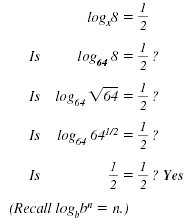
So,
Note:
The solution of is x = 64.
Here is a check.
Example 3
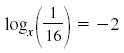
Rewrite x-2 as .
x = ±
x = ± 4
So, We leave the check to you.




 .
. 


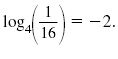 We leave the check to you.