Please use this form if you would like to have this math solver on your website, free of charge.
Solving Quadratic Equations
Quadratic Equation in One Variable: ax2 + bx + c = 0, where a, b and c are real numbers with a
≠ 0. We will solve these equations by several methods.
I. Solving Quadratic Equations by Factoring
The Zero Product Property: ab = 0 if and only if either a = 0 or b = 0 or both a and b equal zero.
II. Graphical Solution
Once the equation is written in the form ax2 + bx + c = 0, we can graph the left side
as y1 and find the x-
intercepts. These x-intercepts or zeros of the function are the solutions to the quadratic equation ax2
+ bx + c = 0.
III. Square Root Property
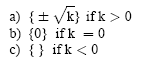
The solution set of x2 = k is:
IV. Using the Quadratic Formula to Solve Quadratic Equations
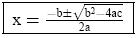
If ax2 + bx + c = 0, a ≠ 0, then:
b2 - 4ac is called the discriminant of the quadratic equation.